

Navigating the world of LGBTQ+ terms can feel like learning a new language. Words that were once unfamiliar are now part of our daily conversations about identity, love, and community. Whether you’re questioning, an ally, or just curious, understanding this language is a powerful step toward respect and inclusion.
Language is deeply personal. It shapes how we see ourselves and how others see us. For LGBTQ+ people, having the right words to describe their experiences can be incredibly empowering. For detailed guide follow Guide to LGBTQ Identities: Spectrum, Labels.
This glossary is a starting point. Definitions can vary based on personal experience and culture, and they will continue to evolve. The most important rule is to always use the terms people use for themselves.
Let’s dive into the A-Z of essential terms.
A
- Abro (sexual and romantic): Describes a person with a fluid sexual or romantic orientation that may change over their life .
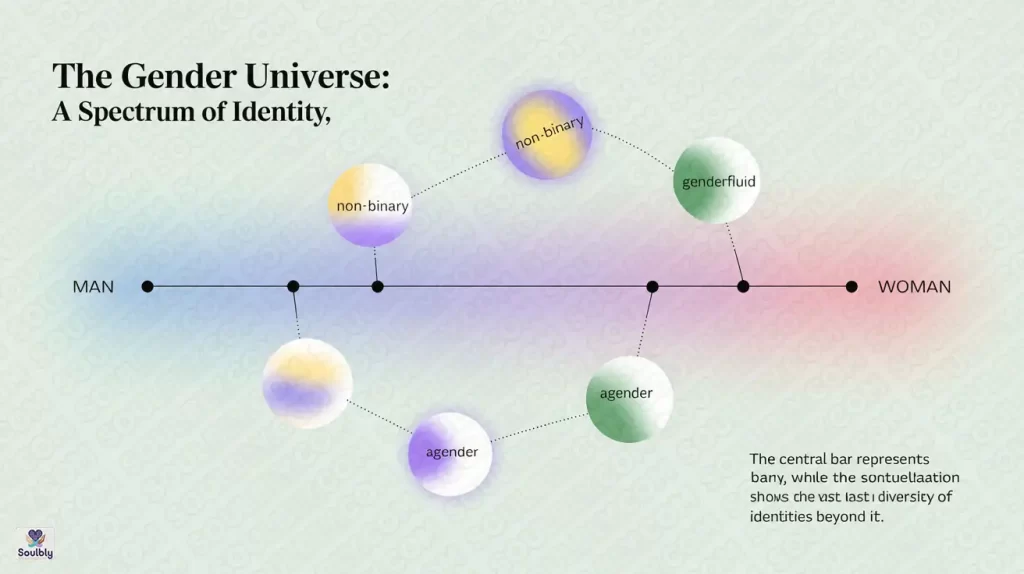
- Agender: A person who has no gender, a neutral gender, or does not identify with the concept of gender itself .
- Ally: A person who actively supports and respects LGBTQ+ people. Allies can be straight and cisgender, or members of the LGBTQ+ community supporting other parts of the community .
- Aromantic / Aro: A person who experiences little or no romantic attraction to others. Aromantic people may still experience sexual attraction .
- Asexual / Ace: A person who experiences little or no sexual attraction to others. Asexuality is a sexual orientation, not a choice, and exists on a spectrum .
- Assigned at Birth: This language is used to highlight that a person’s sex was labeled at birth without their input. Common phrases are “Assigned Female at Birth” (AFAB) or “Assigned Male at Birth” (AMAB).
B
Bi+ / Bi Plus Umbrella: An inclusive term for people who are attracted to more than one gender, including identities like bisexual, pansexual, and fluid .
Bisexual / Bi: A person who is emotionally, romantically, or sexually attracted to more than one gender. The attraction may not be equally split or to the same degree .
Butch: A term, often used by lesbians, to describe a masculine gender expression .
C
Cisgender / Cis: A person whose gender identity aligns with the sex they were assigned at birth. For example, a person assigned female at birth who identifies as a woman is cisgender .
Coming Out: The process of a person first telling someone/others about their sexual orientation or gender identity. This is a continuous and personal journey.
Cupiorose: Cupiorose is a microlabel on the aromantic and asexual spectrum. It describes people who experience no romantic or sexual attraction but still desire romantic or sexual relationships. Think of it as wanting the companionship, intimacy, or structure of a partnership without the internal pull of attraction.
Cupiosexual: cupiosexuality isn’t a contradiction or confusion—it simply describes those who want or enjoy sexual relationships without feeling sexual attraction,
Read Also: The Ultimate Guide to Bystander Workshops: Transforming Bystanders into Upstanders
D
Deadnaming: The act of calling a transgender or non-binary person by a name they used before affirming their gender, such as their birth name. This is generally considered disrespectful .
Demi (sexual and romantic): An umbrella term for people who may only feel sexual or romantic attraction to people with whom they have a strong emotional bond .
F
Femme: A term, often used by lesbians, to describe a feminine gender expression. It can also be used more broadly by other LGBTQ+ people.
finsexual: Finsexual means exclusive sexual attraction to feminine traits or energy in people of any gender – cis women, trans women, femme non-binary folks, or feminine men. It’s about FIN (feminine-in-nature) presentation like soft styles or grace, not biology.
G
- Gay: A person who is emotionally, romantically, or sexually attracted to people of their own gender. It is commonly used to describe men who are attracted to men, but can be used by anyone .
- Gender Dysphoria: The distress or discomfort that can occur when a person’s gender identity does not align with their sex assigned at birth .
- Gender Expression: How a person outwardly presents their gender to the world through clothing, hairstyle, voice, mannerisms, and other factors .
- Gender Identity: A person’s deep, internal sense of their own gender, which could be man, woman, neither, both, or another gender entirely .
- Genderfluid: A person who does not identify with a single, fixed gender. Their gender identity may shift over time .
- Genderqueer: A term for people whose gender identity exists outside of the man/woman binary. It is often used similarly to non-binary .
I
- Intersex: A general term used for people who are born with natural variations in sex characteristics (such as chromosomes, gonads, or genitals) that don’t fit typical binary definitions of male or female bodies. Being intersex is about biological traits and is distinct from sexual orientation and gender identity .
L
- Lesbian: A woman who is emotionally, romantically, or sexually attracted to other women. Some non-binary people also identify with this term .
N
- Non-Binary: An umbrella term for people whose gender identity does not fit exclusively within the binary of man or woman. Non-binary identities are diverse and can include people who identify with no gender, multiple genders, or a gender outside the binary .
O
- Outing: Disclosing another person’s sexual orientation or gender identity to others without their explicit permission. This is a harmful violation of privacy and trust .
P
- Pansexual: Describes someone who has the potential for emotional, romantic, or sexual attraction to people of any gender. Sometimes used interchangeably with bisexual, though definitions can vary personally .
- Pronouns: Words we use to refer to people without using their name (e.g., he/him, she/her, they/them). Using a person’s correct pronouns is a fundamental sign of respect. Some people use neopronouns, such as ze/zir .
Q
- Queer: An umbrella term used by people to describe a spectrum of sexual orientations and gender identities outside of heterosexuality and the gender binary. Historically used as a slur, it has been reclaimed by many in the community .
- Questioning: The process of exploring one’s own sexual orientation, gender identity, or gender expression .
S
- Sexual Orientation: Describes a person’s physical, romantic, and/or emotional attraction to others. It is distinct from gender identity. Common terms include lesbian, gay, bisexual, and straight .
- Straight / Heterosexual: A term for men who are exclusively attracted to women and women who are exclusively attracted to men .
T
- Transgender / Trans: An umbrella term for people whose gender identity and/or expression is different from the cultural expectations based on the sex they were assigned at birth. Being transgender does not imply a specific sexual orientation .
- Transitioning: The process some transgender people undergo to live as their true gender. This can include social transition (e.g., changing name and pronouns), legal transition (e.g., changing documents), and/or medical transition (e.g., hormone therapy or surgeries) .
- Two-Spirit: A term used by some Indigenous North Americans to describe a person who embodies both a masculine and feminine spirit. It is a cultural and spiritual identity that is specific to certain cultures
Beyond the Glossary: Key Concepts for Understanding
Knowing the definitions is one thing; understanding the concepts behind them is another.
Here are some key ideas that will deepen your comprehension of the LGBTQ+ landscape.
- The Difference Between Sexual Orientation and Gender Identity
This is one of the most fundamental distinctions.
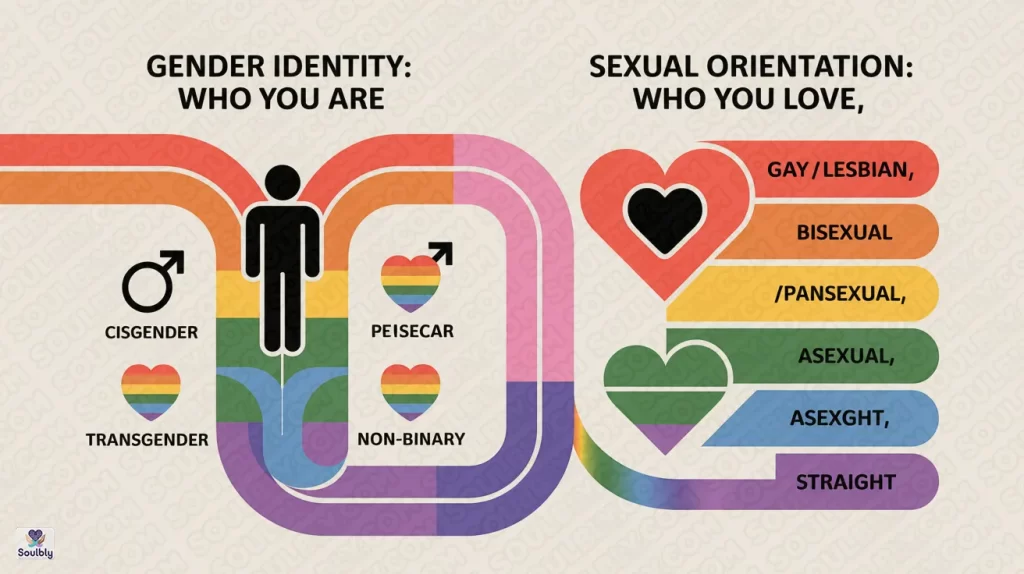
- Sexual Orientation is about who you love. It describes a person’s emotional, romantic, and sexual attraction to others (e.g., gay, lesbian, bisexual, asexual) .
- Gender Identity is about who you are. It is your internal, deeply held sense of your own gender (e.g., man, woman, non-binary) .
A person’s sexual orientation is independent of their gender identity. A transgender man, for example, may identify as gay, straight, bisexual, or any other sexual orientation.
- The Spectrum of Attraction: Understanding Ace and Aro Identities
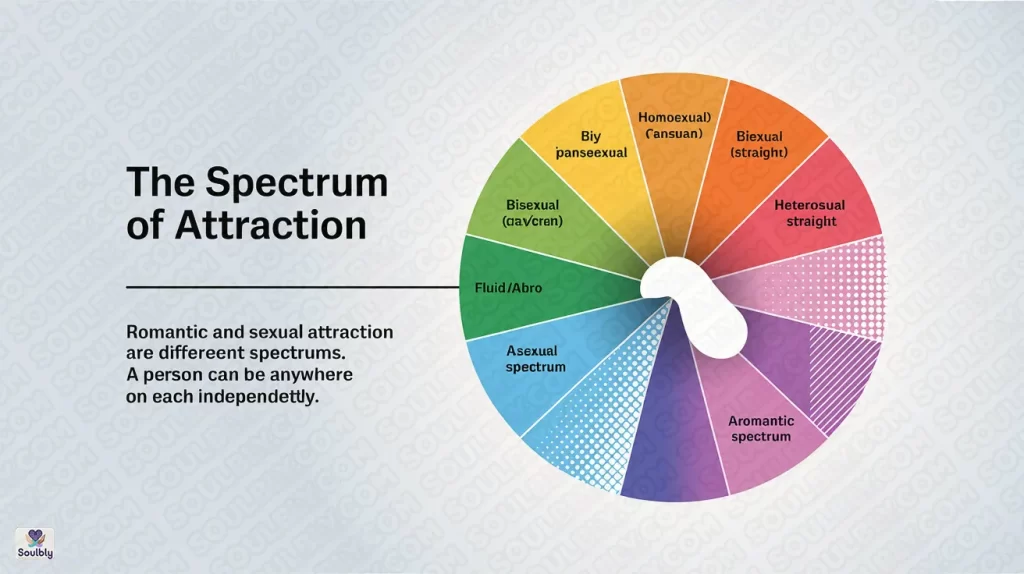
Sexual and romantic attraction are not all-or-nothing experiences. The ace (asexual) and aro (aromantic) spectrum includes people who experience no, little, or conditional attraction .
- Demisexual individuals only experience sexual attraction after forming a strong emotional bond .
- Grey-sexual/Grey-romantic people may experience attraction rarely or only under specific conditions .
These identities highlight that attraction is complex and exists on a wide spectrum.
- The Power of Language: Reclaimed Terms
Language in the LGBTQ+ community is dynamic. Some words once used as slurs have been reclaimed by the community. The most prominent example is “queer,” which is now widely used as an empowering umbrella term and a personal identity.
It’s important to note that while the community has reclaimed these words, it may not be appropriate for people outside the community to use them.
Understanding LGBTQ+ Spectrum-FAQs
What does the LGBTQ+ acronym stand for?
The acronym has evolved to be more inclusive. It commonly stands for:
Lesbian
Gay
Bisexual
Transgender
Queer or Questioning
The “plus” is crucial as it includes other identities like asexual, aromantic, intersex, Two-Spirit, and many others . You may also see variations like LGBTQIA+, where I stands for Intersex and A for sexual/Aromantic/Agender
Is it okay to ask someone about their pronouns?
Yes, if done respectfully. The best way to ask is to share your own first. You can say, “My pronouns are she/her. What are yours?” This normalizes the practice and makes it a routine part of introductions. Avoid asking only people you think “look” trans or non-binary, as this can be othering .
What is the difference between bisexual and pansexual?
There is significant overlap, and some people use the terms interchangeably. Generally:
Bisexual is attraction to more than one gender.
Pansexual is often defined as attraction regardless of gender.
The distinction is personal, and the best practice is to use the label an individual chooses for themselves
Can a person’s sexual orientation or gender identity change?
A person’s understanding of their identity can evolve over time as they learn more about themselves. This is a natural part of self-discovery for some.
However, it is not something that can be forced or changed by external pressure or so-called “conversion therapy,” which is widely condemned as harmful and ineffective
How can I be a good ally?
Listen and Educate Yourself: Use resources like this glossary to learn.
Use Correct Language: Make an effort to use people’s correct names and pronouns.
Speak Up: Gently correct others who use disrespectful language or spread misinformation.
Support and Validate: Believe people when they tell you about their identity.
Accept That You Might Make Mistakes: If you misgender or deadname someone, apologize briefly, correct yourself, and move on. Don’t make a prolonged show of your guilt
Bringing It All Together: The Language of Healthy Relationships
Understanding these terms isn’t just about vocabulary; it’s about building stronger, healthier connections. The principles of good relationships are universal, but for LGBTQ+ people, some aspects require special attention and communication.
Open Communication is Everything: In LGBTQ+ relationships, partners may have different experiences with their identity, family acceptance, or societal pressure. Creating a safe space where both partners can share their feelings, needs, and fears without judgment is the cornerstone of a strong bond .
Mutual Respect Includes Respect for Identity: Respect in a relationship means honoring your partner’s entire self. This includes respecting their journey with their gender identity or sexual orientation, their pronouns, and the specific challenges they may face.
The Importance of Establishing Boundaries: Healthy boundaries are vital. This can include discussing how “out” you are as a couple, how you navigate family events, or how you deal with potential discrimination. Clearly articulating your needs and respecting your partner’s limits builds trust and safety.
This glossary is a living document. Language will continue to grow, and our understanding will deepen. The ultimate goal is not to memorize every term perfectly, but to approach each other with curiosity, respect, and a genuine desire to see and value people for who they truly are. Keep learning, keep listening, and always lead with kindness.
RELATED