

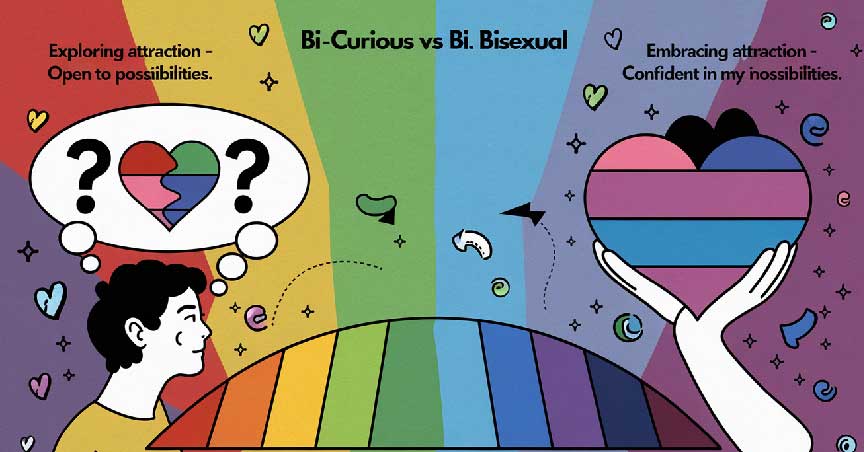
Sexuality is a spectrum, and exploring where you fit can feel both exciting and overwhelming. Whether you’re bi-curious, bisexual, or just trying to understand these identities better, this blog is here to help.
We’ll answer 30 common questions about bi-curious and bisexual orientations, breaking down the differences, similarities, and everything in between.
Here’s a focused list of questions that explore the differences, similarities, and nuances between being bi-curious and bisexual.
These questions can help clarify the distinctions and encourage thoughtful discussion or self-reflection:
Defining the Terms
1. What is the key difference between being bi-curious and bisexual?
Being bi-curious is like being curious about a new hobby—you’re not sure if you’ll like it, but you’re open to trying it out. Being bisexual is like knowing you enjoy that hobby and it’s part of who you are.
So, bi-curious is about curiosity and exploration, while bisexual is about knowing and embracing your attraction to more than one gender.
2. Can someone be both bi-curious and bisexual at the same time, or are they mutually exclusive?
They can overlap! For example, someone might know they’re bisexual (attracted to more than one gender) but still feel curious about certain experiences they haven’t had yet.
It’s like knowing you love pizza but still being curious about trying a new topping. Curiosity and certainty can coexist.
3. How do societal definitions of bi-curious and bisexual differ from personal experiences?
Society loves labels, but real life is messier. Society might say, “Bi-curious is just a phase,” or “Bisexual means you’re equally attracted to all genders.” But in reality, personal experiences are more nuanced.
For example, someone might feel deeply bisexual but never act on it because of their environment, while another person might call themselves bi-curious even if their feelings are strong.
It’s all about how you feel, not what society says.
4. Is being bi-curious a step toward identifying as bisexual, or is it a separate experience?
It can be both! For some people, being bi-curious is like dipping your toes in the water before diving in—it’s a step toward realizing they’re bisexual.
For others, it’s a standalone experience. They might explore their curiosity and realize they’re straight, gay, or something else entirely.
And that’s okay! Life is about exploring and learning about yourself.
5. How do bi-curious and bisexual individuals describe their attraction to multiple genders differently?
A bi-curious person might say, “I’m not sure if I’m attracted to multiple genders, but I’m open to exploring it.” A bisexual person might say, “I know I’m attracted to more than one gender, and it’s a part of who I am.”
It’s like the difference between saying, “I think I might like hiking,” and “I know I love hiking.”
Read Also: Complete Guide to LGBTQ Identities: Spectrum, Labels & What They Mean
Exploration and Identity:
6. How does someone know if they are bi-curious rather than bisexual, or vice versa?
It’s all about how you feel inside. If you’re questioning or unsure, you might lean toward bi-curious. If you feel confident in your attraction to multiple genders, bisexual might fit better.
For example, if you catch yourself thinking, “I wonder what it would be like to date someone of the same gender,” that’s curiosity.
If you think, “I know I’m attracted to people of multiple genders,” that’s bisexuality.
7. Can someone identify as bisexual without having had experiences with multiple genders?
Absolutely! You don’t need to have dated or kissed someone to know you’re attracted to them.
Think of it like this: you don’t need to eat a mango to know you like the smell and the idea of it. Attraction is about how you feel, not what you’ve done.
8. Is being bi-curious always a temporary phase, or can it be a long-term identity?
It depends on the person. For some, it’s a phase—they explore and then settle into a clearer identity.
For others, it’s a long-term way of describing their openness to attraction without feeling the need to label it further.
It’s like someone who loves trying new foods but never settles on a favorite dish—they’re happy just exploring.
9. How do bi-curious individuals navigate their feelings if they are unsure about their orientation?
It’s okay to feel unsure! Many people talk to trusted friends, read about others’ experiences, or even journal their thoughts.
It’s like trying to figure out your favorite genre of music—you listen to different songs, see what resonates, and take your time.
10. What role does experimentation play in distinguishing between being bi-curious and bisexual?
Experimentation can help, but it’s not required. Some people experiment and realize, “Yep, I’m bisexual!” Others might experiment and think, “Hmm, I’m curious, but I’m not sure.”
And that’s okay! It’s like trying a new hobby—you might love it, hate it, or feel neutral, and all of those are valid.
Social and Cultural Perspectives:
11. How do stereotypes about bisexuality and bi-curiosity differ, and how do they affect individuals?
Stereotypes about bisexuality often include things like, “You’re just confused,” or “You’re greedy.”
For bi-curious people, it’s often, “You’re just experimenting.” These stereotypes can make people feel invalidated or pressured to “prove” their orientation.
But the truth is, your feelings are valid, no matter what anyone says.
12. Why is bi-curiosity sometimes seen as less valid than bisexuality in LGBTQ+ communities?
Unfortunately, some people think being bi-curious isn’t a “real” identity because it’s seen as temporary or uncertain. But curiosity is a natural part of self-discovery!
It’s like saying someone isn’t a “real” traveler because they’re just planning their first trip. Everyone starts somewhere.
13. How do bi-curious and bisexual individuals experience bi-erasure differently?
Bi-erasure is when people ignore or deny bisexuality. Bi-curious people might hear, “You’re just experimenting,” while bisexual people might hear, “You’re actually straight or gay.”
Both are frustrating, but they come from the same place—people not understanding that attraction can be fluid and complex.
14. Are bi-curious individuals more likely to face skepticism or invalidation than bisexual individuals?
Sometimes, yes. Because bi-curiosity is often seen as a “phase,” people might dismiss it more easily. But that doesn’t make it any less real.
It’s like someone saying your favorite childhood book doesn’t count because you were a kid—it still mattered to you!
15. How do cultural or religious backgrounds influence the way people view bi-curiosity versus bisexuality?
In some cultures or religions, any attraction outside of heterosexuality might be frowned upon. This can make it harder for bi-curious and bisexual individuals to explore or accept their feelings.
For example, someone might feel guilty for even thinking about being bi-curious because of their upbringing. But remember, your feelings are valid, no matter what.
Relationships and Dating:
16. How do bi-curious and bisexual individuals approach dating and relationships differently?
A bi-curious person might approach dating with more questions, like, “Am I really attracted to this person?” A bisexual person might feel more confident, like, “I know I’m attracted to them.”
It’s like the difference between trying a new sport for the first time and playing one you already love.
17. Can a bi-curious person be in a committed relationship while still exploring their orientation?
Absolutely! Being in a relationship doesn’t mean you stop exploring who you are. For example, you might be in a relationship with someone of one gender while still acknowledging your curiosity about other genders.
It’s like being in a book club but still reading other books on your own.
Read more: Polyamory in LGBTQ Relationships: Exploring Love Beyond Boundaries
18. How do partners of bi-curious individuals navigate their partner’s exploration compared to partners of bisexual individuals?
It depends on the relationship. Some partners might feel insecure or confused, while others might be supportive.
Communication is key! It’s like if your partner wanted to try a new hobby—you’d want to talk about how it affects your relationship.
19. Are bi-curious individuals more likely to face challenges in coming out than bisexual individuals?
It depends. Bi-curious individuals might face skepticism (“Are you sure?”), while bisexual individuals might face erasure (“You’re just confused”).
Both can be tough, but having supportive people around makes all the difference.
20. How do bisexual individuals respond to being someone’s “experiment” if they are dating a bi-curious person?
Some might feel uncomfortable, like they’re being used. Others might feel honored to help someone explore their feelings. It’s all about honesty and respect.
If you’re bi-curious, it’s important to be upfront about where you’re at.
Self-Discovery and Acceptance:
21. What are some signs that someone might be bi-curious rather than bisexual?
If you’re asking yourself, “Could I be attracted to more than one gender?” or “What would it be like to date someone of another gender?” you might be bi-curious.
It’s like wondering if you’d like a new type of music—you’re not sure yet, but you’re open to finding out.
22. How can someone move from identifying as bi-curious to identifying as bisexual, if at all?
It’s a personal journey. You might realize, “Wow, I’m definitely attracted to more than one gender,” and feel comfortable calling yourself bisexual.
Or you might stay curious—it’s up to you! It’s like realizing you love a new food and adding it to your favorites list.
23. What are some common fears or concerns bi-curious individuals have that bisexual individuals may not?
Bi-curious individuals might worry, “What if I’m wrong?” or “What will people think if I’m just experimenting?” These fears are normal, but remember, it’s okay to explore and change your mind.
24. How do bi-curious and bisexual individuals build self-acceptance in a world that often misunderstands their orientation?
It takes time and support. Surround yourself with people who accept you, read about others’ experiences, and remind yourself that your feelings are valid. It’s like building a puzzle—you piece it together bit by bit.
25. Can someone be comfortable identifying as bi-curious indefinitely, or is there societal pressure to “choose a side”?
You can absolutely stay bi-curious as long as it feels right to you. Society might pressure you to “pick a label,” but you don’t owe anyone an explanation. It’s your journey, and you get to decide how to describe it.
Community and Support:
26. How do LGBTQ+ communities typically view bi-curious individuals compared to bisexual individuals?
Some LGBTQ+ communities are welcoming, while others might be skeptical of bi-curious individuals, seeing them as “not queer enough.” But many communities are becoming more inclusive and understanding.
27. Are there specific resources or support groups for bi-curious individuals, or do they share spaces with bisexual people?
Many resources are shared, but some groups specifically welcome bi-curious individuals. Online forums, LGBTQ+ centers, and social media can be great places to start.
28. How can bisexual individuals support bi-curious people in their exploration without pressuring them?
By listening, validating their feelings, and letting them take their time. It’s like being a guide on a hike—you’re there to support, not to push.
29. What are some ways to create inclusive spaces for both bi-curious and bisexual individuals?
By celebrating all forms of attraction and curiosity, and by challenging stereotypes. It’s like throwing a party where everyone’s invited, no matter what they’re wearing.
You can use apps like Taimi to connect with people and form a community on social media platforms like Facebook and others.
30. How do bi-curious and bisexual individuals advocate for visibility and acceptance within and outside the LGBTQ+ community?
By sharing their stories, challenging stereotypes, and supporting each other. It’s like planting seeds—you might not see the results right away, but over time, they grow into something beautiful.
31. Is bi-Curious part of LGBTQ?
Yes, bi-curious is considered part of the LGBTQ+ spectrum. It describes someone who is exploring or curious about attraction to more than one gender, which relates to non-heterosexual experiences and identities.
Some Useful Sources:
1. Human Rights Campaign (HRC) – Bisexual Visibility
- URL: https://www.hrc.org/resources/bisexual
- What it covers: The HRC provides an overview of bisexuality, including definitions, challenges, and ways to support bisexual individuals. It’s a great resource for understanding bisexual visibility and advocacy.
2. GLAAD – Bisexual Resource Guide
- URL: https://www.glaad.org/bisexual
- What it covers: GLAAD offers a comprehensive guide to bisexuality, including FAQs, statistics, and tips for allies. It’s an excellent source for understanding bisexual representation in media and society.
3. The Trevor Project – Understanding Bisexuality
- URL: https://www.thetrevorproject.org/resources/article/understanding-bisexuality/
- What it covers: The Trevor Project provides resources specifically for LGBTQ+ youth, including information on bisexuality, coming out, and mental health support.
4. American Psychological Association (APA) – Bisexuality
- URL: https://www.apa.org/topics/lgbtq/bisexual
- What it covers: The APA offers research-based insights into bisexuality, including its psychological and social aspects. It’s a great source for academic perspectives.
Conclusion
Whether you’re bi-curious, bisexual, or just exploring, your feelings are valid. Take your time, be kind to yourself, and know that you’re not alone. Your journey is yours, and there’s no “right” way to explore it. 🌈